How to choose the right rollator: A complete guide from Mobilex
When mobility becomes a challenge, the right rollator can provide greater support, confidence and freedom in everyday life. But which rollator should you choose?
This depends on factors such as the user's height and walking ability, where the rollator will be used, and whether it will often need to be folded or transported. A model that works well in a small home is not necessarily the best choice for uneven pavements or longer walks.
In this guide, we cover the most important factors to consider when choosing a rollator for indoor use, outdoor use or a combination of both.
Start with the user's daily routine and surroundings
Before comparing models, establish how and where the rollator will be used. This makes it easier to prioritise the features that matter most in everyday life.
Consider the following:
- Will the rollator mainly be used indoors, outdoors or both?
- Will it often need to travel by car, bus, train or taxi?
- Are there narrow doorways or limited space in the home?
- Will it be used on pavements, cobblestones, gravel paths or other uneven surfaces?
- Is a seat needed for rest breaks?
- Does the user need to be able to fold and lift the rollator independently?
- Does the user have difficulties with grip strength, balance or reach?
The situations in which the rollator will be used most often should generally carry the most weight in your decision.
For specific or complex needs, it may help to discuss the choice with an occupational therapist, physiotherapist or another professional who understands the user's abilities and surroundings.
Choose the type of rollator to suit its use
There is no single rollator that is best for everyone. Different models are designed for different situations.
Indoor rollator for narrow spaces
Indoor rollators often focus on low weight, compact dimensions and good manoeuvrability.
This can be an advantage in homes with narrow doorways, small rooms or lots of furniture. Some indoor rollators also have a tray, basket or other storage, making it easier to carry items such as food, drinks or small objects between rooms.
Pay particular attention to:
- the rollator's overall width
- manoeuvrability
- handle height and adjustment options
- a basket, tray or other storage
- whether the model is also intended for outdoor use
A very compact indoor rollator is not necessarily the best solution for uneven outdoor surfaces.
Outdoor rollator for pavements, walks and off-road use
A rollator for outdoor use generally needs to be stable and have wheels and brakes suited to the surroundings in which it will be used.
For longer outings, a seat can also be an important feature if the user needs breaks along the way.
Consider factors such as:
- wheel size
- tyre type
- stability
- brakes
- seat
- the weight of the rollator itself
Larger wheels can often make it easier to negotiate small bumps than very small wheels. However, always check the specifications and recommended use of the particular model.
Rollator for both indoor and outdoor use
Many people prefer a single rollator that can be used throughout the day. This often means finding a compromise between compact dimensions and good handling. For example, a robust rollator may be comfortable to use outdoors but take up more space in narrow rooms. It is therefore a good idea to measure the narrowest doorways and passageways in the home before choosing a model.
Can you use the same rollator indoors and outdoors?
Yes, but it is worth considering whether you actually want to use the same rollator both indoors and outdoors. Think of it a little like shoes: some people do not mind wearing the same shoes outside and inside, while others prefer to change at the door. A rollator used outdoors can pick up dirt, sand and moisture on its wheels, which are then brought into the home.
For some people, one versatile rollator will be the most practical solution. For others, it may make more sense to have a compact rollator for the home and a more robust model for outdoor use.
Will the rollator need to fit in the car?
If the rollator often needs to be taken in the car or on trips, a lightweight rollator can be practical. A lower weight usually makes it easier to lift and handle, but weight should not be the only criterion.
The rollator still needs to suit:
- the user's height
- the user's weight
- the surfaces on which it will be used
- the need for support and stability
If the rollator will be transported regularly, also check:
- how it folds
- its size when folded
- whether it can stand on its own when folded
- whether the user or a helper can lift it
- whether accessories need to be removed before transport
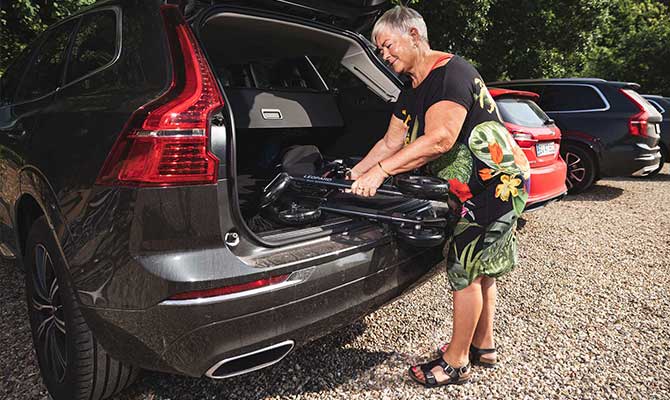
It can be helpful to measure the car boot and compare its dimensions with the rollator's folded size. A lightweight rollator is not necessarily the model that takes up the least space.
Also check how easy it is to fold and unfold the rollator.
For example, see how compactly our Black Panther Compact rollator folds for transport:
Find the right rollator height and size
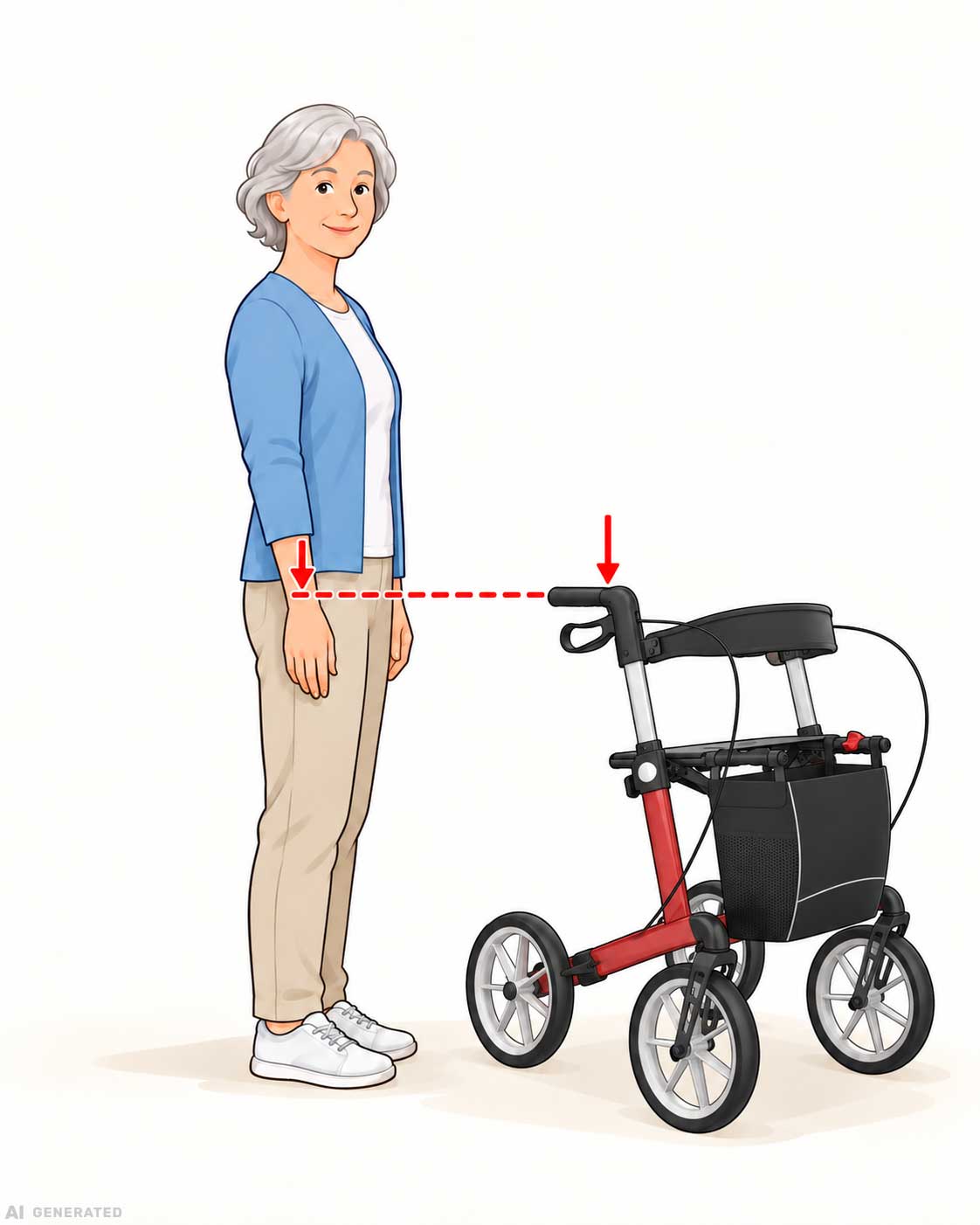
The correct handle height is important for both comfort and control. As a general guide, the handles should be at approximately wrist height when the user stands upright with their arms relaxed by their sides, wearing their usual footwear.
How to adjust the height
- Stand upright wearing your usual footwear.
- Let your arms hang relaxed by your sides.
- Measure the distance from the floor to your wrist.
- Compare this measurement with the rollator's handle height range.
- Set both handles to the same height.
- Try the rollator on a level surface.
If the handles are too low, the user may walk with a pronounced forward stoop. If they are too high, the shoulders may be raised, making it harder to use the rollator effectively. However, size involves more than just handle height.
|
Measurement |
Why does it matter? |
|
Handle height range |
Must suit the user's height |
|
Overall width |
Must fit through the doorways and passageways it will be used in |
|
Width between handles |
Must provide enough space for the user |
|
Seat height |
Is important if the rollator's seat will be used |
|
Folded dimensions |
Matter for storage and transport |
Compare maximum user weight and rollator weight
Two weight specifications are particularly important when comparing rollators: maximum user weight and the weight of the rollator itself.
Maximum user weight indicates the load the rollator is designed to support. Always observe the manufacturer's stated limit. If the rollator has a bag, its carrying capacity will usually also be specified.
Rollator weight tells you how much the rollator itself weighs.
A lower weight can be an advantage if the rollator often needs to be lifted in and out of a car. However, a very light rollator is not automatically the best solution, as stability and handling depend on the overall design.
Remember to check any separate weight limits for bags, baskets and other accessories.
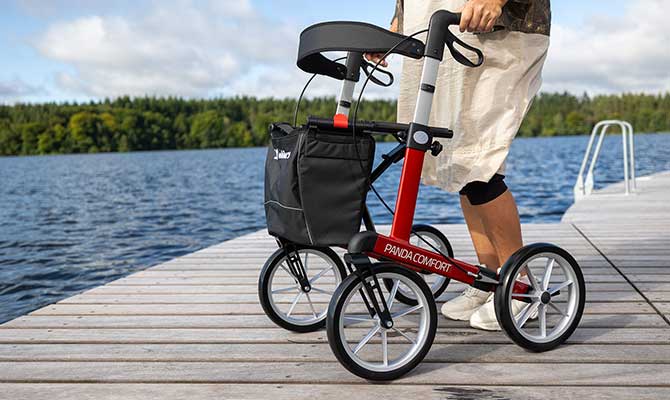
Which wheels should I choose?
Choose wheels to suit the surface. The wheels have a major impact on how the rollator moves, but no single wheel type is best for every environment.
Smaller wheels for indoor use
Smaller wheels are often found on compact rollators for indoor use. They can make it easier to manoeuvre on smooth floors and in small rooms, but are generally less suitable for larger bumps and rough surfaces.Larger wheels can be an advantage on ordinary pavements and uneven paving slabs, as they often negotiate small obstacles more easily. For very uneven paths, gravel or similar surfaces, check the manufacturer's recommendations for the specific model.
Puncture-proof or pneumatic wheels
Puncture-proof wheels generally require less maintenance because they do not need inflating. On some models, pneumatic wheels can offer different handling and comfort, but their tyre pressure needs checking and they can puncture. The best choice therefore depends on both the model and how it will be used.
Check brakes and safety
The brakes are one of a rollator's most important safety features. The user should be able to reach and operate them easily, without needing more grip strength than they have. Many rollators have both standard hand brakes and a parking brake function.
Check the following:
- whether the user can operate both brakes
- whether the parking brakes lock correctly
- whether the wheels, handles and screws are secure
- whether the wheels and tyres are free from visible damage
- whether reflectors or lights are needed for outdoor use
The parking brakes must be engaged before using a seat, if fitted. If a rollator feels loose, is damaged or does not brake as expected, it should be checked according to the manufacturer's instructions before being used again.
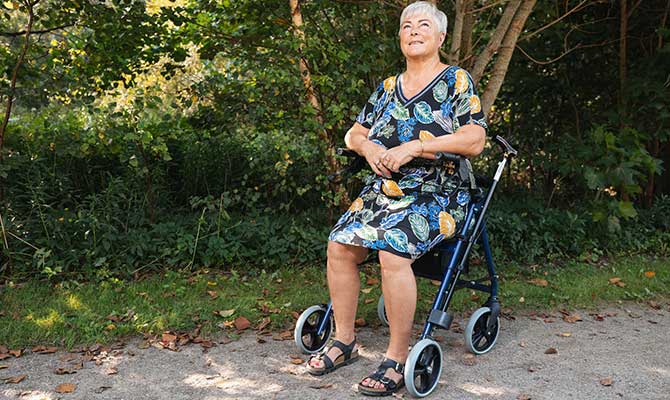
Seat, back support and storage
A rollator with a seat can be practical on longer outings or in places where the user may need a break. The seat height must suit the user, and the rollator must be stable with the parking brakes engaged before the seat is used.
Depending on the model, options may also include:
- a backrest or back strap
- a basket
- a bag
- a tray
- a walking stick holder
Accessories must be designed for the specific rollator and fitted according to the manufacturer's instructions.
Rollator accessories
The right accessories can make a rollator more practical in everyday life.
Examples include:
- a walking stick holder
- a bag or basket
- a tray
- a back strap
- lights and reflective accessories
Always check that accessories are compatible with the chosen model and do not affect the brakes, folding mechanism or stability. View all Mobilex rollator accessories.
Checklist: 8 questions before choosing a rollator
Use this checklist when comparing rollators:
- Will the rollator be used indoors, outdoors or both?
- Can the handles be adjusted correctly for the user?
- Can the rollator fit through the doorways and corridors it will be used in?
- Can the user operate the brakes safely?
- Is the user's weight within the rollator's maximum user weight limit?
- Are the wheels suited to the surfaces on which the rollator will be used most often?
- Will the rollator often need to be folded and transported?
- Is a seat, back support, bag, basket or other accessory needed?
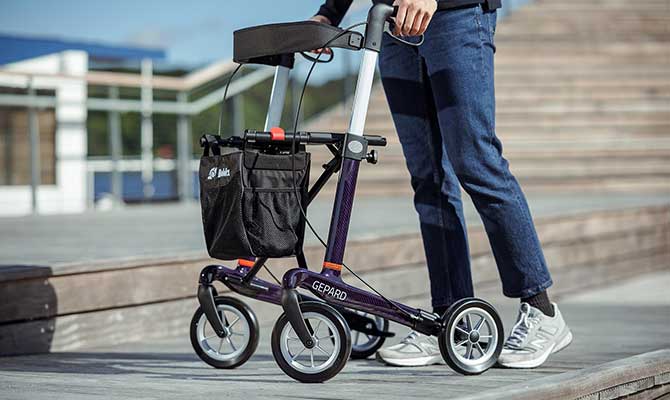
Frequently asked questions about choosing a rollator
How do I choose the right size rollator?
Consider both the handle height range and the rollator's overall dimensions. The handles should be adjustable to the user's wrist height, while the rollator's width must suit the places where it will be used.
Can the same rollator be used indoors and outdoors?
Yes, some models are designed for both. However, it is important to check the width, wheels, stability and the manufacturer's recommended use.
Is a lightweight rollator always best?
No. A lower weight can be an advantage for transport, but the choice of rollator should also take account of stability, height, wheels, maximum user weight and intended use.
Should I choose large or small wheels?
Smaller wheels can be practical in narrow indoor spaces, while larger wheels are often better suited to pavements and minor bumps. The choice should depend on the surfaces on which the rollator will mainly be used.
Should you try a rollator before buying?
If possible, trying a rollator can make it easier to assess handle height, brakes, manoeuvrability and overall comfort.
Find the rollator that suits your needs
When choosing a rollator, it helps to compare models using the same criteria: height, width, rollator weight, maximum user weight, wheels, brakes, seat and folded dimensions.
Explore the Mobilex range of rollators and compare the specifications of the models that suit the user's daily routine.
Find a Mobilex dealer or become a dealer
Looking for a Mobilex dealer near you? Find a dealer and get help choosing the solution that suits your needs.
Do you run a shop or business and want to sell Mobilex products? Contact us to learn more about becoming a Mobilex dealer.